Forgotten Turning Points in History That Changed the Modern World
History is often remembered through famous wars, revolutions, and world leaders. Yet some of the most powerful moments that shaped today’s society are the lesser-known turning points hidden between the pages of textbooks. These forgotten events changed politics, science, trade, culture, and even the way modern nations function. From unexpected deaths to overlooked diplomatic decisions, history has often turned on moments that seemed small at the time.
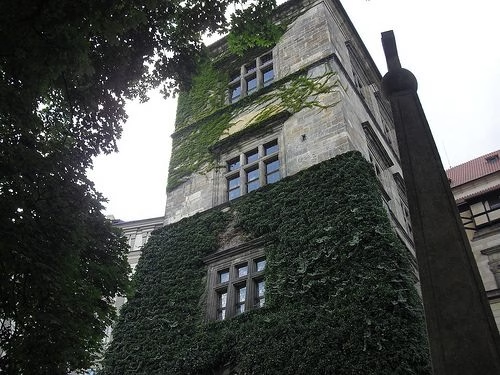
One remarkable example is the Defenestration of Prague in 1618. At first glance, it may seem like a strange local political protest in which officials were literally thrown out of a castle window. However, this dramatic act triggered the Thirty Years’ War, one of Europe’s most devastating conflicts. The war redrew borders, weakened empires, and laid the foundation for the rise of modern nation-states and diplomatic systems that still influence international politics today.
Another forgotten turning point was the death of Ogedei Khan in 1241. The Mongol Empire was expanding rapidly into Europe, and many historians believe the continent could have been completely transformed under Mongol rule. But Ogedei’s sudden death forced generals to retreat eastward for succession discussions. This single event halted the Mongol advance and allowed European kingdoms to develop independently, shaping the political and cultural identity of the Western world as we know it.
The Norwegian Heavy Water Sabotage during World War II is another event whose impact is often underestimated. Norwegian resistance fighters destroyed facilities producing heavy water, a key element in Nazi Germany’s nuclear research. Had this mission failed, the timeline of World War II—and the balance of global power—might have looked very different. This courageous act helped delay Germany’s nuclear ambitions and influenced the eventual structure of the post-war world order.
Climate also played a surprising role in shaping the modern world. The Little Ice Age, a long period of cooling from the 14th to the 19th century, disrupted agriculture, economies, and traditional social systems. Food shortages and economic stress weakened feudal structures and encouraged trade innovation, urban growth, and scientific thinking. Many historians connect this environmental shift to the rise of capitalism, global exploration, and the Enlightenment—major pillars of the modern age.
One of the most fascinating forgotten turning points is the Industrial Revolution’s “slow spark.” While many people focus on steam engines and factories, the real shift began through centuries of small inventions, trade networks, and experimental thinking. The combination of earlier discoveries eventually caused a technological explosion that transformed transportation, communication, labor, and wealth creation. Today’s digital economy, mass production systems, and global trade all trace their roots back to this gradual but world-changing transition.
Even simple mistakes have altered history. The wrong turn taken by Archduke Franz Ferdinand’s driver in Sarajevo placed him directly in front of his assassin, triggering World War I. While political tensions were already high, this accidental moment became the spark that changed global empires, borders, and future conflicts. The aftermath led to the collapse of monarchies, the rise of new ideologies, and the geopolitical conditions that shaped the 20th century.
These forgotten turning points remind us that history is not only made by famous leaders or major battles. Sometimes, a death, a climate shift, a failed expansion, or even a wrong turn can redirect the future of civilizations. The modern world—with its governments, economies, technologies, and global alliances—stands on countless hidden moments that rarely receive the attention they deserve.
Understanding these overlooked events gives us a richer view of how fragile and interconnected human progress truly is. The biggest lesson from history is that small moments often create the largest consequences, and what seems minor today may become tomorrow’s defining turning point.